
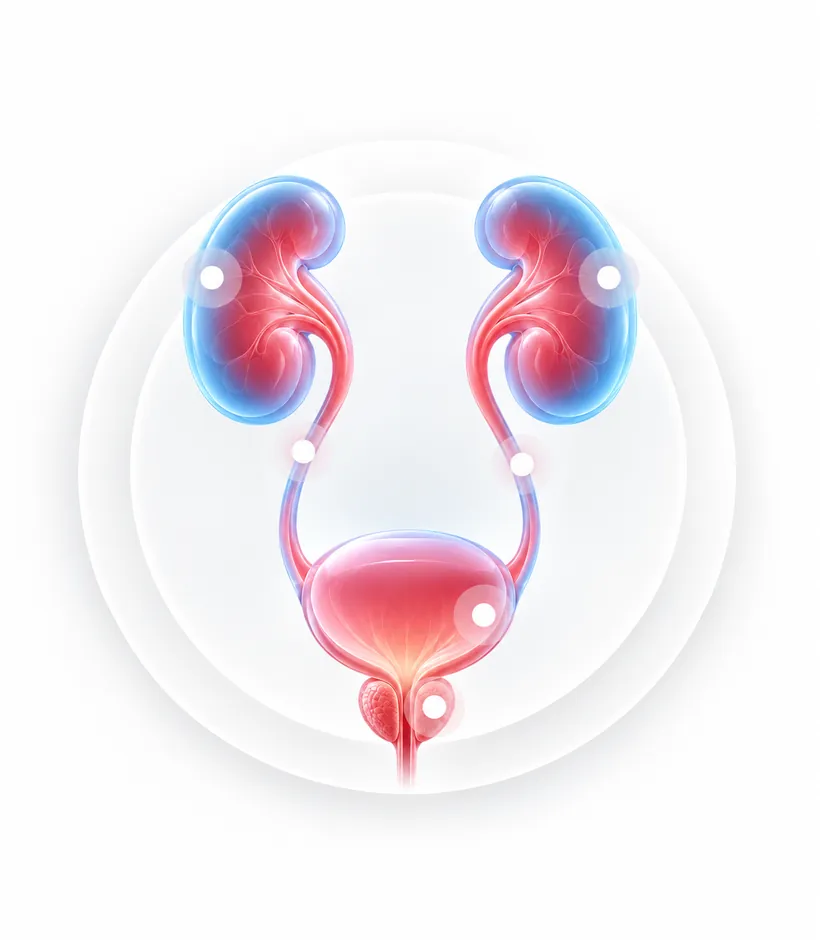
Tap a glowing point on the diagram to see what each organ does.
Start with symptomsUrology, explained by a urologist
Clear answers aboutyour kidneys & bladder
Kidney stones, the prostate, urinary infections and laser surgery, explained in plain language and medically reviewed by Dr. Anand Utture, MCh.
Check a symptom Your urologist
Dr. Anand Utture
MBBS, MS, MCh (Urology), DNB
27+ years · laser stone & prostate surgery
Meet the doctor
Your urologist
Dr. Anand Utture
MBBS, MS, MCh (Urology), DNB
27+ years · laser stone & prostate surgery
Meet the doctor
Quick answer
How much water prevents stones?
Enough to pass 2 to 2.5 litres of urine a day, usually 2.5 to 3 litres of fluid.
All answersWritten and reviewed
by a practising urologist
Every answer here comes from Dr. Anand Utture's 27+ years in urology and 7,000+ procedures. It covers what a symptom usually means, what cannot wait, and what each treatment involves, so you arrive at your consultation informed rather than worried.
What is my bodytrying to tell me?
Pick what you are noticing. Each card says what it commonly means, what cannot wait, and when to see a urologist.
Sudden side or back pain
Sharp, wave-like pain below the ribs that moves towards the groin is the classic sign of a kidney or ureteric stone. Nausea, vomiting and restlessness are common with it.
Go to an emergency department the same day if the pain comes with fever or chills, repeated vomiting, very little urine, or if you have only one working kidney.
If the pain has settled, still get an ultrasound or CT KUB. A stone that has stopped hurting can keep blocking the kidney.
Blood in urine
Pink, red or cola-coloured urine can come from an infection, a stone, an enlarged prostate or, less often, a growth in the bladder or kidney. Some foods and medicines can also change the colour.
Seek care the same day if you pass clots, cannot pass urine, or have fever with it.
Visible blood should always be checked by a urologist, even if it happened once and caused no pain. Painless bleeding is exactly when a check matters most.
Burning or frequent urination
Burning, urgency and passing small amounts often usually point to a urinary tract infection (UTI). Stones, prostate problems or a narrowed urethra can cause similar symptoms.
Fever, shivering, back pain or vomiting with urinary symptoms can mean the infection has reached the kidney. See a doctor the same day.
See a urologist if UTIs keep coming back (two in six months or three in a year), if you are a man with a UTI, or if symptoms return after antibiotics.
Weak stream or night-time urination
In men over 50 this is most often benign prostatic hyperplasia (BPH), a non-cancerous enlargement of the prostate. A urethral stricture or a weak bladder can look the same.
If you suddenly cannot pass urine at all, or your lower belly is painfully swollen, go to an emergency department. This is acute retention.
Book a check if you wake two or more times a night to urinate, strain to start, or feel the bladder never fully empties. Tests usually include a flow study, an ultrasound and a PSA.
Leaking or sudden urge
Leaking when you cough or lift is stress incontinence. A sudden urge you cannot hold is overactive bladder. Infections, diabetes and some medicines can make both worse.
New leaking with leg weakness, numbness in the saddle area or loss of bowel control needs emergency care.
Most bladder control problems improve with a proper diagnosis. Keeping a three-day bladder diary before your visit makes it faster.
Testicular pain or a lump
A painless lump in the testis should be examined promptly. Pain with swelling is often infection (epididymitis), but not always.
Sudden, severe pain in one testis, especially in teenagers and young men, can be torsion. That is a surgical emergency, and the first few hours matter.
Any new lump, heaviness or change in size should be checked with an examination and a scrotal ultrasound.
This guide is general education, not a diagnosis. If you are worried, speak to a doctor. In an emergency, go to the nearest hospital.
Questions patientsask every day.
Short, direct answers first, with the full guide one click away.
Medically reviewed by Dr. Anand Utture, MCh (Urology), MMC Reg. No. 66401 ·
What size of kidney stone can pass on its own?
Stones smaller than about 5 mm usually pass within a few weeks with fluids and medicines that relax the ureter. Stones of 5–10 mm may pass but often need help. Stones larger than about 10 mm rarely pass and usually need treatment such as RIRS, ESWL or Mini-PCNL.
Read the full guideWhich is better for kidney stones: RIRS, Mini-PCNL or ESWL?
No single procedure is best for every stone. The choice depends on the stone's size, position, hardness and your anatomy. ESWL suits smaller, softer stones. RIRS clears most stones up to about 2 cm without any cut. Mini-PCNL is preferred for larger or very hard stones.
Read the full guideHow much water should I drink to prevent kidney stones?
Aim for enough fluid to pass about 2 to 2.5 litres of urine a day. For most adults that means 2.5 to 3 litres of fluid, and more in Mumbai's heat or with heavy sweating. Pale yellow urine is a good guide. Cutting down on salt and adding citrus also helps.
Read the full guideIs a DJ stent painful, and when is it removed?
A DJ stent is a thin tube placed after some stone procedures to keep urine draining. Mild discomfort, a frequent urge and pink urine are common and settle with medicines. It is usually removed in a short day-care visit after one to four weeks. It must never be forgotten, because an old stent can block and form crusts.
Read the full guideHow long is recovery after laser kidney stone surgery?
After RIRS most people go home the same day or the next morning and return to desk work within two to five days. After Mini-PCNL, expect one or two nights in hospital and about a week before normal activity. Heavy lifting waits until your urologist clears it.
Read the full guideIs an enlarged prostate the same as prostate cancer?
No. Benign prostatic hyperplasia (BPH) is a non-cancerous enlargement that becomes common after 50. It does not turn into cancer, but the two can exist together and cause similar urinary symptoms. A PSA blood test and an examination help tell them apart.
Read the full guideWhen is surgery needed for an enlarged prostate?
Most men start with medicines. Surgery such as bipolar plasmakinetic resection (BPKRP) or laser enucleation is advised when medicines stop helping. It is also advised after an episode of urine retention, repeated infections or bleeding, bladder stones, or any effect on the kidneys.
Read the full guideWhat PSA level is normal?
There is no single normal number. A PSA under 4 ng/mL is often used as a reference, but the normal range rises with age and prostate size. Infection, a recent catheter or cycling can raise it temporarily. A rising trend over time matters more than one reading, so results should be read by a urologist.
Read the full guideWhy do I keep getting urinary infections?
Repeated UTIs usually have a cause worth finding. Common ones are incomplete bladder emptying, a stone, low fluid intake, diabetes, changes after menopause, or a narrowing in the urethra. An ultrasound with a post-void residual check is a simple first step.
Read the full guideCan men get urinary tract infections?
Yes. UTIs are less common in men, so when one happens it usually has an underlying reason, such as prostate enlargement, prostatitis, a stone or a stricture. A UTI in a man should always be followed by a urology evaluation, not just a course of antibiotics.
Read the full guideWhen is blood in the urine an emergency?
Go to an emergency department if you pass large clots, cannot pass urine, feel faint, or have fever with the bleeding. Even a single painless episode that stops by itself needs a planned urology check. Painless visible blood can be an early sign of a bladder or kidney tumour.
Read the full guideWhat does a urologist treat?
A urologist treats the kidneys, ureters, bladder, prostate, urethra and male reproductive organs. That covers kidney stones, enlarged prostate, urinary infections, blood in the urine, incontinence, urological cancers, male infertility and erectile problems, in both men and women.
Read the full guideNo answer matches that yet. See all FAQs.
Laser urology,explained simply.
Most kidney stones today are treated without a single cut, through the body's own passage.
In flexible ureteroscopy (RIRS), a scope thinner than a pencil lead passes up through the urethra and bladder into the kidney. A holmium or thulium fibre laser then breaks the stone into dust. For enlarged prostates, bipolar plasmakinetic surgery removes the blockage from the inside. Both are usually done as day care or with a single overnight stay.
- No-cut options for most stones
- Day-care recovery where suitable
- Back to desk work in days
Kidney stone procedures compared
| Procedure | Best for | Anaesthesia | Incision | Hospital stay | Back to routine | Worth knowing |
|---|---|---|---|---|---|---|
| ESWL (shock-wave lithotripsy) | Kidney or upper-ureter stones up to about 1–1.5 cm that are not very hard | Usually none or light sedation | None | Day care | 1–2 days | May need more than one session |
| RIRS (flexible ureteroscopy with laser) | Kidney stones up to about 2 cm, including lower-pole stones | General or spinal | None, done through the urinary passage | Day care or one night | 2–5 days | A temporary DJ stent is common |
| URS (ureteroscopy) | Stones stuck in the ureter | General or spinal | None | Day care or one night | 2–4 days | Often the quickest relief for a blocked ureter |
| Mini-PCNL | Large (over 2 cm), branched or very hard kidney stones | General | About 1 cm keyhole in the back | 1–2 nights | About 1 week | Highest single-sitting clearance for large stones |
Typical figures for uncomplicated cases. Your urologist will recommend a procedure based on CT findings, stone density and your overall health.
Reviewed byDr. Anand Utture
Every guide on this site is written or reviewed by Dr. Anand Utture, a consultant urologist in Mumbai with more than 27 years in urology. His focus is laser kidney stone surgery (RIRS and Mini-PCNL), prostate care and minimally invasive urology.
He trained in Mumbai and completed fellowships in laser urology in New Zealand and advanced urology in Singapore. The aim here is simple: give you enough understanding to ask the right questions before any treatment.
Full profile & credentials- MBBS, MS, MCh (Urology), DNB (Genitourinary Surgery) · Maharashtra Medical Council Reg. No. 66401
- Fellowship training in New Zealand and Singapore
- High-volume RIRS, Mini-PCNL and holmium / thulium laser surgery
- Bipolar plasmakinetic prostate surgery (BPKRP)
Every symptom deserves a straight answer.
Consult Dr. Utturein person.
Appointments, clinic timings and directions are on the doctor's main website. Choose the location nearest to you.